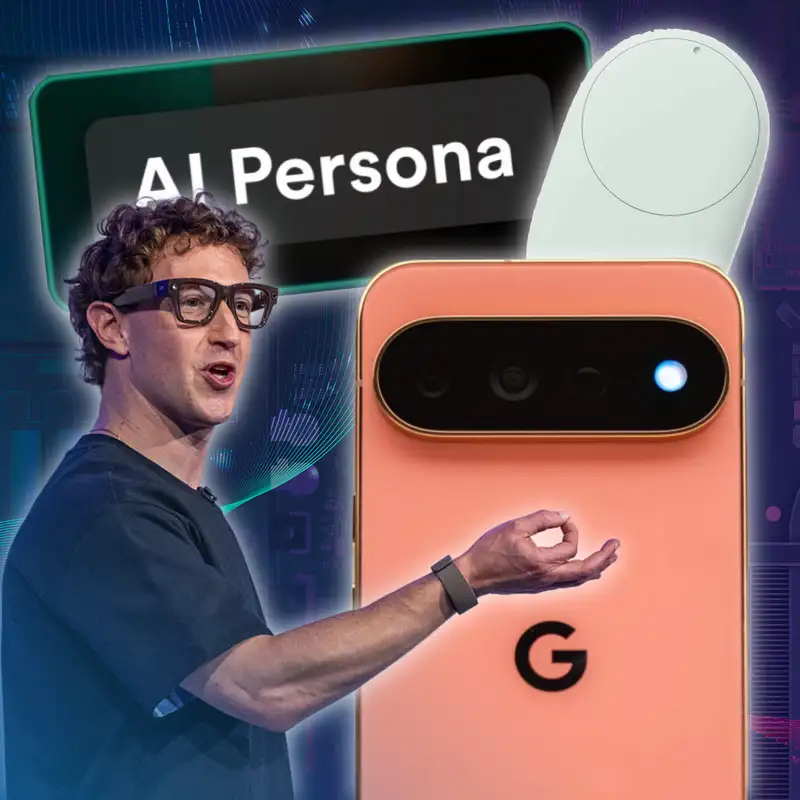
Pixel 11 Has Some Good Ideas, Zuck's AI Fever Dream, Spotify's Worst Idea Yet
Download MP3Open the pod bay doors, Hal. Welcome to
Primary Technology,
the show about the tech news that matters.
Big news this week, Google had its Pixel
event.
We're gonna get into all the features that
they announced,
the hardware. Mark Zuckerberg wrote an AI
manifesto,
which sounded like a fever dream.
We'll get into that. Claude is gonna
watermark its writing and you'll
be able to tell whether text was actually
generated with AI.
Spotify's trying to kill podcasts,
YouTube made it harder to get monetized,
and a ton more. This episode is brought to
you by Decagon and you,
all of the members who support us
directly.
I'm one of your host Stephen Robles,
joined by my friend Jason Aten.
How's it going, Jason?
It's good because our our espresso maker
works again.
So I'm f I'm
Now listen,
caffeinated.
it always is a good day when you're
caffeinated.
I'm pre caffeinated. I cold brew it up
before every show.
That's how I'm able to come out the gate.
That does
not look like a cup of coffee,
Steven. It looks like you're drinking
Here's the thing. I don't want to.
a smoothie there.
This is gonna be I'm just anticipating
Put it in a room.
the YouTube. I listen, listen.
We have the fancy ninja espresso maker.
I love doing that. But in the morning,
I drink cold brew because there's very
high I drink concentrated,
Concentrated.
non-diluted
chameleon cold brew. You're supposed to
cut it with water.
I don't cut it with anything. I cut it
with my mouth.
All right. And I drink the chameleon cold
brew.
Put some half and f in there. And I know
there's gonna be some comments about this.
I'm just bracing myself for the YouTube
comments.
I put protein powder in the cold brew and
I blend it up,
and that is my breakfast. And it is the
breakfast of champions,
Jason, because that I turn cold brew into
podcasts.
That's literally what I do. Okay?
And videos. But you know. I'm just I
listen.
Whenever I say I put cold protein powder
in cold brew,
people get upset. But listen, it works.
It works for
I mean, I didn't
even know you went that far. So literally
you are drinking a smoothie.
That's the thing.
I mean kind of, kind
of. You probably know the quote from
today.
It's a movie I've seen.
Yes. I I did
just to be clear, I I knew where the movie
was from,
but I looked it up because I feel like the
rest of the conversation is very good.
But anyway, it's from ~ Space Odyssey,
Stanley Kubrick, two thousand and one.
That's that's exactly right.
Yes.
I saw that movie probably in my early
twenties and it felt like a trip.
Like I don't even know what happened.
I remember there's an obelisk.
I know that the the computer traps in the
sh like there's just crazy stuff going
on there. I need to watch it again,
I think. Probably apropos in today's
world.
And I need
Yeah.
to watch iRobot again.
And Jurassic Park.
Jurassic Park. Okay, we had some great
comments by the way.
Everyone watching on YouTube, thanks for
that.
People said Bending Spoons is the
velociraptor of tech companies,
which is an excellent comment.
Actually, correct. Hope you guys enjoyed
that.
And we have a bunch of five star review
shout-outs to give.
We're so close to five hundred reviews.
Thank you for your help. Douglas Sanchez
from Brazil.
We have several international listeners
and viewers.
We actually a picture of our night in
another continent.
We'll get to that. But he said Jason's
humor is hilarious and they make
a fantastic team. Look at that,
Jason. You got a lot of love in in this
week's
Use. They even use your name. They didn't
even say the other guy.
Yeah, they didn't they even use my name.
They didn't say the other guy.
This is
We have to get
the bring the joke back because the maybe
newer listeners don't know.
This is how I know I've made it.
That's it. That's
I have a name.
it. You have a name. So Far and So Bad
from the USA.
Looks forward to each new episode.
Jeff Woo ninety nine from the USA says
these guys great.
Best tech podcast. I listened to Carpick
from India.
Yes, I finally tried Raycast and he gave
us five stars for that.
I have an entire video on Raycast.
Do you what are you a spotlight guy?
Do you have a special launcher?
~ I use Alfred.
Alright, well tune into the next Mac Power
users,
okay, Jason? Cause me and David
I'm not s I'm not switching.
we go head to head. I got some thoughts,
okay.
It's just not
it's not important enough to me to think
about switching.
I do have ~ sh I do have Spotlight
assigned to a different hotkey so
I can still pull it up because the new
version of Spotlight's better.
I just Yeah, yeah, yeah,
~ I mean better than before. Yeah.
yeah, yeah. That's all I'm saying.
It's better
than before 'cause well, it's like
Spotlight was incredible,
then it was useless, and now it's
Sure.
like fine.
Well, and here's here's my thing.
Spotlight was ~ meh. And then in macOS 26,
it's really good. Clipboard history,
file search, quick keys, all very good.
But the macOS 27 Spotlight, I feel like it
gets slower because you got Siri
AI in there at the same time. And they're
always like whenever
you type something into the new spotlight,
Mac OS 27 or on your iPhone, it's always
like fighting.
Like, is this an AI thing? Is he just
trying to open an app?
What are we doing here? And so I talk
about that.
Yeah, I use Alfred and I'm probably not
ever gonna switch unless they stop making
it and whatever because I use it thirty
nine thousand times a day and I just
Yeah, yeah.
cannot afford the mental overhead of
switching to something else.
We're gonna talk about Alfred and
launchers in the bonus episode today.
It's it's been decided. It's now been
decided.
Okay, good. I love
when I can talk you into a bonus episode ~
topic.
Perfect. Perfect. I one always comes one's
always comes up.
Yes.
~
Chris from Washington said, I'm in the
camp of assigning apps
to particular spaces and hope hopping
between them,
whether I'm on a work machine or personal
machine.
So yeah, I'd kind of do that too.
I'm doing it right now. We talked about
spaces on macOS last week.
Right now, I have my primary tech podcast
space where I have Notion,
Riverside, Safari tab group with all the
links I'm going be sharing today,
and a PDF of the sponsor read.
That's my space. And then on the other
space,
I got ~ work stuff. I got final code over
here.
So yeah. You're still not a spaces guy,
right? You haven't tried? Not open right
now,
You have final cut right now? Okay.
but usually that's open. No, no.
Okay. That's the whole point of the dots.
I quit I quit all that. I'm not a monster.
Yeah, I know. I'm not a monster.
essay Digital from the USA gave us six out
of five stars.
Thank you for that. And podcast seven two
eight had a question.
Do we listen to anything in the shower and
what books are we reading?
A little little bit different.
I will say rarely do I listen to something
in the shower,
but when I do, it's a podcast.
And
What books are we reading? I actually just
started reading what is the book?
I think it's a like a Seneca Stoicism
book.
I forget what it's called on the Jason's
face.
It just gave me a crazy look. there's that
and there was I forgot
the books I're reading. I'll have to bring
them for next time.
Are you reading anything, Jason?
Well, I mean I do read I do read books.
I don't read them in the shower.
Just to be clear.
No, no. Two different questions.
Yeah.
~
I are you reading the Daily Stoic?
Are you reading
No no no no no.
Let Letters from a Stoic? Meditations by
Marcus Aurelius.
No, I already read Stillness is the Key.
I've read some of that. There's I don't
know,
Why do I know this many stoicism books?
I can't figure it out.
it's a it's
a book it's the Seneca like life is short
but long if you know how to
use it or whatever. Like whatever that
book is.
That sounds a lot like Zuck's Manifesto.
We'll get to that later. ~ I listen to
podcasts sometimes in the shower.
That's about it. I don't listen to music
in the shower.
Right. Same.
I just
sometimes will listen to a podcast.
~ It's kinda weird because I have a lot of
podcast listening time.
I don't really have to do that in the
shower.
Also, I can only do it in the shower if
there's like no one else around because
then
Yeah. R
they just think I'm talking to some dudes.
Now if you were, yeah. ~ On the Shortness
of Life is the book,
from Seneca. So just I actually want to
get the name there.
Great. I
and the last book I've read is I just it's
taken me a while because I have read
it in spurts. I just finished Apple and
China,
so
there you go. Yeah, I'm in the middle of
that one still.
And ~ my wife and I just finished The Body
Keeps the Score,
which is a heavy book, but is is very
good.
All right, I wanted to thank the pins have
made it to more places.
Andre in South Africa sent me an this
incredible photo.
It is the medieval night riding the polar
bear with Table Mountain
in the background in Cape Town,
South Africa. Amazing. The night is
traversing the globe.
Super fun.
And Steve sent me an email. He and ~ his
spouse went to the Tour de France
and took the medieval knight on the polar
bear,
has a picture of it outside a French Apple
store,
and sent me a bunch of other pictures.
And so very, very kind, very fun.
We're all over the world, Jason.
The knight is making
I love it.
it.
Yeah, it's very cool. on one funny post I
want to say,
you know, we sometimes try to say hey
dingus to not activate everyone's voice
assistance, and then we forget and we say
it a thousand times in an episode anyway.
But Chipionic found a car that has a
license plate,
a vanity license plate that says Dingus.
How bad
do you want to just drive up rolling on
your window and be like,
hey dang us?
Hey Dingus.
That's the that was perfect. So yeah,
that exists in the real world.
All right. There's a ton of pixel news.
Google's hardware, software. Is Alex
Cooper really gonna switch from an iPhone
to an Android? I wanna talk about that.
Because the Google the Made by Google
event was is quite a thing.
So, but real quick, just want to plug
before we get into that.
Apple Immersive is gonna get more content.
MLB games, since we're basically a sports
ball podcast.
Major League Baseball, Friday night
baseball is gonna have several games
in Apple Immersive and while I don't you
know,
I'm not a big sports guy, I am from New
York and I am a Yankees
fan just because that's required if you
live in New York,
unless you're a Mets fan, but nobody's
perfect.
just kidding. I probably just made a bunch
of people mad.
I'm so sorry. I don't know.
Yeah,
yeah, that's not the other guy.
I just want to be clear.
I don't know, it's not the other guy.
But yeah, you'll be able to watch the
Yankees Red Sox game in Apple Vision
Pro live as well as other games.
I'm curious how this will go. Ben Thompson
was already upset without this even
happening yet, because if you had watched
the NBA games in Apple Vision Pro,
they switched the camera angle throughout
the game,
and his argument is that could be jarring.
Just stick me in one place as though I am
actually experiencing it,
which I totally get. I watched an NBA game
in Apple Vision Pro as well.
And
I'm curious how they do it. Are they going
to be switching you all over the park?
Are you going to able to choose a seat?
Probably not, but yeah. I don't know.
I'm going to I'm going to watch it.
I'm going to put on Vision Pro to watch
it.
I wanna just say and I don't I mean,
he's probably right as often as he's not,
but Ben Thompson is a hundred percent
right on this.
Apple has no idea what they're doing with
this.
It's such a stupid idea. They're gonna
have bespoke commentators.
~ you just listen,
Yeah, that's not good.
go l subscribe to Dithering and just
listen to it.
I don't have to get into the whole thing.
But the
Yeah, yeah.
point is you have the most incredible way
to feel like you're actually at the game,
but they're treating it like it's a two D
broadcast and they're gonna just
Right.
And then you're gonna just move you all
over where you should just get to
be able to pick a spot. It it should be
like theater.
Right. Yes.
Isn't that Lystigoris?
Where you can choose where you wanna be
sitting in the theater.
Yes, exactly. Yeah.
You should just be able to choose where
you wanna be at at the game
and you can just watch the whole game.
And if you wanna have a replay,
you just hit rewind and move to a
different seat.
Like
Yeah.
this is so simple.
And I would I long thought, and I actually
sent the team,
I think, this suggestion or whatever,
like orchestra concerts, musicals,
whatever. If you if they had a deal with
some venue or a number of venues where
you could buy a ticket to watch an event
live,
whether it's you know, a pop music type
concert,
if it's actually a stage musical,
rock concert, whatever, and you just get
the center seat.
A little ways back and you can experience
the concert right there,
live, with the live crowd around you and
hearing everything that's going on.
I feel like that would be a particular
selling point.
One, people just can't get out to events
like that.
Artists like I follow ~ Leve because sh ~
my oldest son really likes
her as an artist. I like her music as
well.
She's like a jazz artist. But she doesn't
come to the US super often to tour.
And she's only been here like once in the
last couple of years.
And like that would be an artist for like,
man, it would be awesome if I could
experience a live concert.
My son could experience one in Apple
Vision Pro because you can do that.
It doesn't matter where she was.
You just stick one of the immersive
cameras.
And you just need one then. And I feel
like you'd be able to multiply your
efforts
by just putting one immersive camera in a
venue where you can buy that seat
as if you're there. Because when you're
actually at an event,
you just have that one perspective.
You can't move around. Just do that.
So I don't know.
Yeah,
if only there was like an international
monopoly where you could make a deal
to put these cameras in every single venue
in America.
See, the joke there is Ticketmaster
Right. Live Nation is literally that.
Just I guarantee
That monopoly.
you Apple could get a deal done with Live
Nation and
Yes.
just be like, here's the d well we're
gonna do this,
we'll cut it. We'll cut you guys in.
We'll just like you know, we'll just give
you a cut of every time someone uses this
app. It's like I this is they're thinking
Yeah, yeah, yeah.
of it like T V. It's not T V.
Right, exactly. We should we should be on
the team.
They should do a brain trust and we'll c
we'll come out there.
We'll come out and yeah, we'll talk about
it.
All right. The Pixel Eleven event was last
night.
Odd time for a live keynote, but also all
the YouTube videos came out earlier
in the day, like Mr. Who's the Boss,
MKBHD, a bunch of creators, Brian Tong all
posted videos about the Pixel Eleven
and the entire lineup. And then there was
the live keynote at six PM Eastern
on a Wednesday, hosted by Trevor Noah.
Which was interesting. We'll get into
that.
On the face of it, the hardware,
I don't think, is the biggest story.
You know, there's a new Tensor G6 chip.
The camera hardware is a little better on
the Pixel 1111 Pro.
They are more expensive, $100 more,
but the base storage is now $256.
Ramagedin. The 11 Pro now starts at 12
gigs of RAM instead of 16.
So there's a bunch of like little hardware
updates and improvements.
The fold is out there, slightly improved.
Still thick, but there's a lot of software
things that I think
are pretty interesting. Google's taking
some shots at Whisper Flow
and doing some interesting software things
with the camera.
There is one hardware thing that Joanna
Stern was very excited about,
which is the light on the back of the
Pixel phones.
There's now a BlackBerry
Blackberry light.
light where it's a notification light in
the camera bar.
There's multiple colored LEDs,
so this is not just like a solid
Color flash. This is like actually
different colors that can meld
and do animations kind of. But it can only
tell you when one of your favorites
are calling and when Gemini is doing stuff
on the phone.
Which if you've asked Gemini to do stuff
on the phone,
you're probably looking at the screen,
just you know, figure. And for when your
favorites call,
that's interesting, but I think it would
probably be more beneficial
if you could tell it when they text you.
Or customize what apps like will light up
this thing.
It's called the highlight L E D H I L I G
H T.
I don't know. You can also make a shortcut
that just flashes the flashlight when
you get a call. So that's I'm sorry,
Well, actually isn't that an accessibility
feature?
it's an it's an accessibility feature
because it's not a shortcut's automation
for
Okay.
calls, unfortunately, but it is a
accessibility feature.
You could just have it flash your
flashlight,
but
Right,
because there are a lot of people who
that's the only way they would know that
their
phone is ringing. So that makes a lot of
sense.
Yeah, a hundred percent. Yeah.
So yeah, I
d it is kind of a weird restriction.
It seems like I mean, I don't want this.
I don't want my phone to flash at me when
anything's happening.
I turn most notifications off.
I just don't just like I don't even want
to know people are trying to get
a hold of me. But if I did, it would be
kinda cool just to be able to
see that that is you know the the reason I
hated Blackberry is that
the light just never went.
I always had emails, I always had
notifications.
Right, which is on all the time.
I yeah.
But I do think it should
you should be able to decide what it's
for.
Yeah, exactly. So and they s Google says
they're working on more customizations.
But there's a couple of software things
that I want to focus on.
This first one is called Rambler.
And so this was a segment, this is Trevor
Noah,
and he was using this feature and it's now
going to be built into the Pixel phones.
It is dictation, but it's like dictation
supercharged.
And I've actually been using WhisperFlow a
little more on my Mac,
especially as I've been doing the whole
can do vibe coding.
Because when I have a long thing I want to
tell an LLM to do,
it's just easier to just talk it rather
than type it all,
you know, when there's a lot of things.
And Whisperflow is really good because you
can correct yourself mid-dictation.
You can say, no, actually, I meant this.
And it understands all of those little
quirks in your speech and provides
a very clean message or transcription when
you're ready to send.
Now, the annoyance with whisperflow on
iPhone is.
Is that you have to switch to a
third-party keyboard in order for it
to have that full functionality of pasting
what you just dictated and being able
to turn it on. There's a weird action
button shortcut workaround,
but it's just nowhere near as convenient
as on the Mac.
And Pixel is saying we're gonna build this
just right into our phone.
And so this Rambler feature is basically
that.
It is the Whisperflow style transcription
that is very accurate,
but also smart enough to know when you've
corrected yourself or you say,
actually say this.
Trevor No did a demo and it's it did
exactly what you would expect.
Like correcting himself, changing what
he's saying.
Bottom line, I want this on iPhone.
And I know we're not going to get it
because Apple just improved
the ejectation and all it did was just get
slightly more accurate.
But it is nowhere near the Whisper Flow
self-correction type transcription.
And this is a feature. I would not switch
to a Pixel for this,
but man, I so want this. Or let Apple.
I don't know if
Figure out a way where it can do a third
party dictation service like Whisper
rather
than have to use the built in one.
So I want this feature. That's all.
Yeah, I mean, we are getting to a point
where people just are talking it's weird.
Like we're g we talk at our phones but no
one's there listening.
Like we used to talk at our phones all the
time.
That was the whole point
Sure, sure.
of having a phone, but now people are just
talking at it so you don't have
to talk at someone. It's like just
Yeah, exactly.
take these words, turn into text so I can
send the text somewhere,
whether that's to a human or a robot.
That's fine. I I I don't find like on the
iPhone,
I just use dictation and it's generally
fine for what I'm doing.
It's fine.
Yeah, it's fine.
I
don't know that it's great, but I do feel
like it's mostly fine.
I used and on the Mac I used the
dictation.
I think we talked about this when I had a
problem with like my wrist
and it's like that's a problem 'cause I'm
a writer so I type all day
and I just spent a week having to talk to
my computer and it was fine.
What was it that made you think I need a
third party app to do this?
Like you're doing it that much or?
Well, David Sparks, I mean, just talked it
up so much.
And when it comes to how I've been
prompting Claude for things on my app,
there'll be times where I like I have a
bunch of bullets in a bear note
of changes and bug fixes that people have
reported and they're
not formatted enough where I can just copy
and paste that list into Claude
and say go because there it's lacking some
clarity and context.
And so what I will do is I'll look at that
bulleted list and think to myself,
I could type this all out.
And be more specific, or I could just hold
a key on my keyboard,
talk through these bullet points in a
messy way that's not super precise.
And Whisperflow not only dictates but
cleans it up for me in a way that
I can just hit return and send it to
Claude.
And so that use case has been nice.
And we're gonna get to Claude actually
watermarking text that
it generates and what I feel a little
weird about that.
in because of how I use it. And so I might
start doing it even more because
I want it to be my words and not Claude's.
So for those reasons.
Yeah. Do you think that this is a feature
that's gonna convince people
to buy pixels? Okay.
No, not at all. No one's gonna buy
a pick. I mean, listen, Google stacks this
event with celebrities.
I mean, Stephen Curry's in this,
Trevor Noah's hosting it, Alex Cooper from
Caller Daddy.
I'm gonna about to talk about her segment.
And like, it's hilarious how much juice
Google tries to like put into this Pixel
event, but everyone just still buys the
Samsung Galaxy S26.
So it's like, I don't know. I mean,
they're great, it's great hardware and
they're really interesting features.
I'm gonna talk about all the camera stuff
and the creator suite in a minute,
but yeah, no one's gonna buy a Pixel
because of that.
Yes.
Yeah.
I don't know. I mean, it's in some ways
the same thing,
like Microsoft makes Surface stuff and
they're good laptops.
Google makes very good phones.
It's just not a lot of people buy them,
but they're sort of just putting these
things out there because what's really
important to them is that Android exists.
Right. And it's Google's like,
hey, here's what an ideal Android phone
with Gemini and that's the other thing
is they increase Gemini intelligence.
It works with more apps, a bunch of apps
you never heard of,
plus Zoc Doc and ~ Open Table.
you know, so they're they build those
features in first so they can show
you what's possible. But again,
I don't think people are going to switch
to use it.
But speaking of switching, there was this
entire segment of the Made
by Google event where Alex Cooper goes on
stage and she talks
to somebody from Google and they
Talk about how easy it is to switch to an
Android phone from an iPhone
and how Google worked with Apple earlier,
like throughout this year. So when you
transfer your stuff,
not only it brings your pictures,
it also ~ get brings your passwords over
from Apple Passwords.
And that switching is super easy.
Alex Cooper even asked the guy,
like, So are my group texts gonna be good?
And he was like, Your group texts are
gonna be great.
And it's like, well.
Yes, RCS has gotten way better.
Group techs are better. Still not the same
as iMessage,
but fine. And I just wanted to mention
this segment.
One, Alex Cooper has a very popular
podcast,
Caller Daddy. And so let's check after the
iPhone 18 launch,
a couple weeks after that, what phone is
Alex Cooper using.
That's all I'm saying. I'm saying this is
all fine.
Great. Switching is now easy. Let's see
what happens when the rubber meets the
road.
Because one of the my favorite parts of
old Twitter.
was when someone would make a deal with
Samsung or whoever and talk about
how great the new phone Android phone is
and then like Oprah and then someone looks
at a tweet that they post and it says sent
from iPhone and everybody would just call
that out. Which you don't have that
anymore,
the like the Twitter posted from this
thing.
But when you have a big video podcast like
Alex Cooper,
I'm sure she's gonna hold her phone at
some point.
Let's just all see. I'm just curious.
Let's see. Is it gonna be a pixel?
Or is it gonna be the iPhone eighteen when
that comes out,
~ later Sept late September? So we'll see.
That's all.
To be clear, I think it was actually
Samsung's account that posted something
that
said sent from iPhone. But I also think
Okay, very good. Very good.
that it was like I've El at one point I'm
pretty sure Alicia Keys
was like the creative director for Samsung
and then people like spotted
Yes.
her using an iPhone or something like
that.
So yeah.
It was that and
I r I do think ~ Oprah was one because she
like talked about it
and something and then she tweeted it
whatever was from her iPhone.
There was a bunch of cases, like if you
just Google celebrities that yeah,
anyway.
To be fair, the switching thing is
actually really cool that the Apple
Sure. Yeah.
and Google work together. This
was but it
It's also very self serving. It's like d
we're not a we're a duopoly.
We're not monopolies. Just be clear,
we are not monopolies.
Right.
See, you can easily go back and forth
between the two.
You can't go to anything else because
nothing else exists because we have
the entire market, but we're not a
monopoly.
But it is nice. I've used it obviously
some people like us,
and by people like us, I just mean weirdos
who change phones all the time.
I don't there's
Sure, sure.
nothing special about us. It's just often
I'm carrying multiple devices and
Yeah.
mo often that's
couple times a year going back and forth
between an Android phone and
a and it's very nice that I can just take
my main iPhone,
put a selection of things on a Google f on
an Android device and use it with
all of my information on it. That's super
helpful.
I don't know how many people use this
because they're like,
I've finally done it. I've given up the
iPhone.
I'm going to Android or the other way
around.
Yeah, I don't I mean you would use it once
and then probably
not switch platforms again for a long
time,
but yeah. I don't know. It's it's good
that it's there.
I'm sure after like Apple did all this
work or whatever,
Google also slides the invoice across the
table for Gemini powering Apple
intelligence. It's like, yeah,
by the way, don't forget to pay your bill.
But you know, it's a it's a friendemyship.
Frenemyship. Friendship
They're
they're even better of best of frenemies.
Well that's open AI on Apple, but yeah.
Well, I I think they're just straight
enemies now,
Jason. I don't I don't know if there's any
friend of me.
They need each other, Stephen.
That
that integration is going away,
I'm sure. The open AI one. But so that's
that.
A couple of things on the cameras.
So the cameras have improved hardware in
the pixel devices,
but some really cool software features.
And they're really gearing towards
creators with a couple of them.
One is called Magic Capture. And this is a
feature where in the demo
it shows that you can just hold the Pixel
phone and
And it's basically it looks like it's
capturing a video and has
a couple basketball players doing it.
And the Pixel is just going to choose
moments that are that would make great
photos
and capture those photos. And this is not
the same as pulling still frames from
a video. And in the demo, they zoom into
the photos to show like this
is a high-quality photo. This is not just
a screen grab from a video.
And you don't even like the person demoing
it wasn't even looking at the phone.
Like you're just kind of holding it at
chest height.
Kind of like how your parents or
grandparents hold something when they're
trying
to like capture something in a in the
school,
whatever. They're just kind of like
holding the phone randomly and pointing
it in random directions. But the magic
capture will then just pull great photos
from
moments it decides is really good and you
can decide which ones to keep.
That's a cool feature built in.
Again, it's software, not necessarily,
I don't know if you need the latest
hardware to do it,
but that's a cool feature. And then the
creator focused features,
these are things that
You know, I would love see on an iPhone
too.
Things like you can have a teleprompter
right there while you're recording
in the camera. It has social media safe
lines so you can see what how like frame
it up for vertical video and horizontal.
You can see like what is going when you
crop it to that vertical nine by sixteen,
what it's gonna look like. These are nice
little features that are just added in.
You know, I feel like many times Apple has
started down this path,
like with the Clips app.
And was like, we're gonna make an an app
where you can edit short form video,
but it's gonna be square, and then we're
gonna forget about this app forever.
And it's like if they had if Apple had
just pushed on that for a couple years
and innovated, like that could have been a
useful creator tool.
And Apple is doing some of that,
like into Final Cut, they added the
ability to do captions and overlay it,
but there's not a lot of style.
So just credit to Google actually building
features that I think would help
creators.
If any of them use pixel phones,
but I don't know if they do.
Two things. One, I think like I always
feel very weird,
especially when Google releases camera
features,
because I'm like I don't want to get into
the like what's a photo thing.
But it's like y okay.
We'll we'll touch on that. We'll touch on
that.
But I also think the reality is they just
know how most normal people
how many terrible photos they take.
And st I don't know, have you ever I'm
sure you've had this experience,
but like people will send you photos and
you're like how
How is it possible you took such a
terrible photo of this moment?
Like, do you n do you not
W were you running away?
know how to point your phone correctly?
Like it's like do you not understand
things like maybe I mean,
I understand that the teenagers like
taking pi one,
you point five pictures of their foreheads
and so they do that on purpose.
Yes, yes.
But like, I
don't think that our parents are trying to
do that,
right? And actually I'm not picking on my
parents because my mom
was a photographer and does a great job.
The point is, like
People will look at a photo and be like,
your photo for is so much better.
I'm like, I just pointed the phone at it
and pushed the button.
Like I didn't do it, like I don't I don't
know.
The w the one habit I see is so many that
yeah.
Stop stop pinging to Zoom, stop all that
stuff,
just tap the button. And I think but
Yeah.
Google knows, like, no no no no.
People are terrible at taking photos.
So we're gonna do all this work because
Gorgeous.
what they really want is just to have a
good end result and we can argue about
all of those details and and that's fine.
The other thing I was just gonna say is
like the creator,
like all these tools and stuff,
that's great.
I you I'm sure have this experience.
But like right now, if you took a vertical
video on your phone and you're like,
this would be cool. I want to add
captions.
I want to do this. There isn't actually
like AI should have solved this problem
by now. I mean cap cut, whatever.
Like it's it's
Yeah, yeah.
but it's still like dialing that stuff in
is not super easy anywhere.
And so I actually think the more that pe
the Google and Apple could build these
features in in a way that's really
accessible,
because
That's what people want to do with this
stuff.
They're taking
Yeah.
these short videos so that they can post
them on Instagram or TikTok or whatever.
So I think that's actually a positive,
even though I'm still in the camp of like
people should just be able
to take better photos. The cameras should
stop trying to do so much.
Well, sure. I think you know, the pinching
and zooming is one thing.
I'm also usually I cringe when someone
like moves
the phone so quickly after hitting the
shutter button.
Like so often I see someone like hit the
shutter button and the camera's down.
And like for me, I always like give it a
second just to make sure it's like
captured
and still, you know what I mean?
I don't know if you you see that kind of
stuff,
but
Yeah,
also, honestly, you should just turn off
all the camera control features
and you should use it as a shutter button.
It's the best way to use your camera.
A hundred percent. Just hold it there and
just hit the camera control button
constantly. And that's
Yeah. Yeah.
the people don't do that though.
They're tapping the thing and yeah.
This should I still tap the shutter
button,
No, no, no.
but
Don't do the don't tap the shutter button.
see, I like to do it because pressing the
camera control button I feel like moves
the phone a little too much, even if I try
really hard to hold it still.
Whereas tapping the shutter button I could
do so lightly it doesn't move the phone.
We had this entire conversation once.
I know we had this entire conversation.
Okay. Okay.
I'm just reiterating my habit and
we won't get we won't have to get into it.
But we will say one other thing about the
camera stuff:
Pixel is adding these cam Pixel camera
looks is the feature.
And in the Google Pixels are giving you
more control.
It's not just filters on top of the photo.
This gives like photo gen like photo
styles on iPhone,
where when you decide the look or how you
want the photo
composed, it's actually affecting the
entire photo process on the camera,
like from the sensor, the processing of
HDR,
all of that. So it's not just a filter on
top of a photo.
It will affect how the photo is taken.
And they are giving users more granular
control over these looks.
And for instance, if you look at this
example and it's in the Verge article,
a link in the show notes as well,
you can choose like, you know what,
don't crush the highlights so much.
I kinda want
kind of the more natural look where this
is what it looked like when I
was there in real life. Or you just don't
want the HDR crank so much.
And if you want a ~ the shadows to
actually be shadowy,
or if you want the grain because it's low
light,
it's giving users the option to have less
processing or at least process
it differently. So it doesn't look so much
like a smartphone photo.
And like I've seen a lot on social media
and TikTok people using like
old cameras because it has cool looks
But basically the cool look is just minus
all the computational photography.
Like the
Right.
the cool look is this is an old camera
that all it did was capture what
was in front of it and there were no
settings and no processing.
And especially younger generations are
like,
hey, this is cool. Like I actually want
pictures that look like this.
And so the Pixel is actually doing that
and giving users more control.
Again, photogenic styles gives you some
control on the iPhone,
but the Pixel is going even further,
giving more granular control and being
able to make it look like not
as processed of a photo.
Which I think is good. I mean,
yeah. Nice.
I agree.
I agree. Yeah. And I do think that the
headline of that story is great.
Google's making pixel cameras better by
making them worse.
Exact exactly.
Good job. Good job, David.
Exactly. All right. A couple of last quick
things.
~ I just closed a tab. no.
Show's over.
The show is over. I inadvertently closed a
tab.
No, the Pixel Tag. So Google did announce
a and yeah,
announce because it doesn't come out till
November,
an air tag style tracking tag.
It's called the Pixel Tag. It's gonna be
$29 for one.
It's gonna be $99 for four. It is oblong.
It's not like a perfect circle like an air
tag.
It is a kind of a oval shape. It is still
a coin battery,
year of battery life. Google says it will
be able to ping
the entire Android network. So it seems
like maybe any Android phone doesn't have
to be a Pixel, will be a part of the
network,
the find hub network for Google.
So yeah, if you are in the Pixel universe,
you can have an AirTag like thing.
There you go.
I
I do think this is a perfect example of
how good Apple
is at designing the form of a product
around its limiting factor,
which is the little CR whatever,
twenty thirty two battery.
Twenty thirty two battery. Yeah,
yeah, yeah.
Because this looks like
This actually looks a lot like the one of
the versions of the Google
TV Chromecast remote. Looked a lot like
that.
Yeah, it does, yeah.
It's like this is this is weird in the
sense that like the air tag
is the perfect form factor for this.
And people are like, well, you can make it
smaller if you made it rechargeable.
No, no, no. It's perfect that you can just
twist it,
take out a battery every year,
put it in. I don't have to recharge it.
I don't have to you the battery won't
degrade over time.
It'll just die and I put a new one in.
But I I just
Yeah, yeah.
think not throwing any shade at this thing
other than I have no use for it.
I just think it should we should
appreciate for all of our criticisms of
Apple,
the air tag is actually such a perfect
example of like,
no, the limiting factor of this is the
size and shape of the battery
and they built the perfect device around
that.
Yeah.
And I'm curious like the range of
something like this Pixel One.
I'm sure Lexi Civides, who was on the show
a few weeks ago,
she actually did a whole find my
comparison with the current products.
And so I hope she does a an updated video
with this specifically.
It doesn't come out till November,
but I will be curious the range,
because AirTag two range is insane.
I remember I did a short video and it got
over two hundred feet,
I think, and I still had to precision find
my arrow on screen,
which was pretty wild. So yeah.
That's pretty cool. All right.
Well, that was the Pixel event.
There was also the Pixel Watch 5 that has
breathing emergency detection
and also insulin resistance trends.
Not so much like individual measurements,
but that's there in blood pressure trends.
So you got Pixel Watch 5, which I do I
think it looks nice.
I mean it's a nice circle face.
That's cool. Also, tap to share is going
to be updated,
so you'll be able to just tap two Android
phones together as long
as they're a Galaxy 8, the Z Fold 8,
the Fold 8.
And a Pixel Six series of newer,
which actually going back pretty far.
Shout out Bump. You remember the Bump app,
Jason? Yeah.
Yep, I do.
That was on iPhone too. Like the Bump app
existed on both platforms,
I feel like.
And
it was a big deal before you could just
have those contact posters that
you could share by putting the phone next
to each other.
But in this I mean, bump was like what it
was like,
two thousand ten, eleven maybe.
I can just remember going to conferences
and it's like,
Here you go, wanna bump? Which is a weird
thing to say to someone,
Bump. What a
but
bump. Maybe the name. If it was a better
name,
it might have been better. But anyway.
Alright, Zuck had this huge AI manifesto I
want to get into.
Claude is gonna watermark text that it
generates.
I have some interesting feelings about
that.
And yeah, Spotify is ~ maybe trying to
kill podcasting.
We'll get into it. But before we get to
all that,
we're gonna take a break and thank today's
sponsor,
which is Decagon. Listen, Decagon,
if you have a team and you're dealing with
tons of support tickets,
multiple channels, your customers have
high expectations.
You might have thought about using AI for
customer support and you might
be limited in time and how time consuming
those options are and training it.
Well, that's why Decagon is here for you.
Dekagon helps companies create
personalized concierge-style customer
experiences
with AI agents across chat, email,
voice, and SMS. They're available 24-7,
they feel natural to talk to, and can
resolve customer requests on their
own so businesses can keep up with
requests without losing that personal
touch.
And Dekagon plugs directly into your
existing teams so agents can get live
quickly.
And because workflows can be updated using
natural language,
teams can make changes themselves without
long engineering cycles.
That's huge. You don't need to be a
programmer to affect how it responds
and do you update it. You can just your
team can do it today.
That means less time spent managing
workflows and more time focused
on customers and ROI in weeks.
And once live agents can pull up to date
information,
take action on requests.
And understand the context behind any
conversation.
Also, Decagon gives your team full
visibility into why agents make decisions
and what's happening across every
conversation.
Decagon helps power millions of
conversations every day for brands
you already know and love like Avis,
Affirm, Fanatics, and Aura, like the Aura
Ring.
So if you're ready to transform your
customer support,
go to Decagon.ai slash primary to get a
personalized demo and see what Decagon
can do for your team. So check out Decagon
at Decagon.ai.
~
slash primary. That link's also in the
show notes.
That's decagon.ai slash primary.
Thanks to Decagon for sponsoring this
episode.
And also thanks to all of our members who
support the show,
which just a quick plug, you can become a
member.
There's a link down in the show notes if
you're not already a member.
$2.50 a month or $25 a year. You get an
ad-free version of the show.
You get the bonus episode, you get the
unedited feed,
which also includes a pre-show,
you get primary tech daily, you get all
the things.
So we'd appreciate your support.
Thank you for all those who already do
that.
You
get a sneak peek into something I'm
working on.
That is true. We talk about Jason's next
app,
which is pretty exciting. So, you know,
it's right there. All right, Jason,
I read Mark Zuckerberg's entire AI
manifesto.
It is very long. It's like over 6,500
words.
I have just a quick question for you.
How it's okay if you did. Did you read any
of this?
Okay, you read the whole thing.
I read the whole thing. I even made notes,
Stephen, incontextually.
I made notes too.
I made notes. One, the title is The Future
Is For Everyone.
Subhead The Path to a Positive AI Future.
I don't like that there's the in the title
and the in the subtitle.
I think you should drop one of the the's.
You know what I mean?
Sure, but the Yeah.
That's a that's a joke. That's a social
network joke.
Just throwing
that out there. Do you think you're a
writer,
Jason? I think our listeners know that.
Is Zuck a good writer?
I don't know that it would be fair to say
that Zuck wrote this.
I mean, I don't this is like how many
words was this thing?
Sure. Sixty five hundred? About sixty five
hundred.
A lot.
The guy running the largest advertising
platform in the world doesn't have time
to write sixty five hundred words,
does he?
Well, that's a good question. So high
level,
this is like Zuck trying to I guess make a
call like who do you who is this for?
It seems like maybe this is a call to the
governments and also other
AI companies and also trying to tell the
people that he is he thinks AI
is for the people and needs to be
available to all people,
free and open, and the only way we all
succeed is everybody gets AI.
on their own terms and I'm gonna talk
about the personal agent
he talks about several times. Who who is
this for,
do you think?
Okay, this is helpful context.
Do you wanna start by c going through it
and then we can we can talk about
why this exists? Okay. Okay.
Sure. Let's do that. Let's do that.
'Cause I think that the why it exists is
the only part that matters,
but if we start talking about that we'll
never get to the other part,
so
Okay,
all right. So I'll I'll quickly jam
through this.
I made a bunch of notes, I'm not gonna go
through all of it,
but he does make a call to Steve Jobs
talking about like all
the revolutions in technology,
and he mentions in a line the kid in a
garage who thought personal computer
should
be for everyone. And that I don't know.
I was a little bit like, All right,
all right. You d don't don't invoke the w
he never said Steve Jobs,
but everybody knows what he's talking
about.
but he's always wanted to be Steve Jobs.
Always want to be Steve Jobs. So a couple
poll quotes from this manifesto.
First of all, he's trying to make
superintelligence the term.
And I think he and Meta are the only ones
using that term,
superintelligence. He has the
superintelligence labs,
but fine. He's really trying to make that
a thing.
Some of the bold claims that he has about
the near future of AI.
He says everyone will have an
exceptionally capable personal agent that
understands
you, your goals, and everything you care
about.
That's a bold claim. Like,
Sure, there are agents right now,
but he's saying very personal.
He also believes that everyone will have
one.
He says the economy will become more
entrepreneurial because of this.
Adults will have a superintelligent
learning assistant that knows exactly
how to teach you new job skills,
new languages, new hobbies, or anything
else you're interested in.
Side question: if the superintelligence
can teach me all of that,
why do I need to learn it?
Well, hold on, let's pause.
Okay, sure, please.
Go back to the first thing you said.
Everyone's gonna everyone's gonna
The capable person Yeah.
have a capable This is written by someone
who probably
has fifteen personal assistant type
people,
right? And
~ sure, for sure.
~ also I'm pretty sure that none of them
know everything about him.
Sure, sure.
And I'm pretty
sure he doesn't want that. And I
definitely don't want all of my personal,
everything deep personal, everything about
me living on a server somewhere
so that an AI agent can get to it.
Because what happens when the other agent
breaks into it?
Because it's not like that ever happened
before.
Right? Like i this is a I don't think this
is a future people actually want.
I don't think it's feature people actually
want.
And he also I I think he talks out of both
sides of his mouth because throughout
this entire manifesto, he is trying to
make the plea that AI needs
to not be centralized to a few specific
powerful companies,
slash people, slash governments.
It needs to be democratized. But then in a
different breath,
he says, quote, We Meta will offer free
versions that will be accessible
to billions of people.
So it's we want, we don't want a
centralized anything of power,
but also we will be the one that gives
everyone this power.
And it's like, I feel like that's a little
contradictory.
Fine. He also has this wild example of
trying to prove this point
that if one person had a AI
superintelligent lawyer
in the courtroom, but the other person
didn't,
that would be an unfair advantage.
So the future we need is that everyone
has.
A superintelligence lawyer on their side,
and then these superintelligence lawyers
will argue,
I guess, and do the case. And it's like
recently on Movies on the Side,
we reviewed the movie Mercy, which is
exactly this situation,
and it doesn't go well. Just throwing that
out there.
But just seems like a weird, I don't know,
it's a weird example. But these are the
kind of examples that he pulls
to try and prove his point.
Yeah, I feel like there's this is I think
that didn't they talk about this
on ~ The Verge cast recently because
Zuckerberg wrote about like what a
I think it's Neely who talks about
software brain.
There's
Yeah, yeah, yeah.
so much software brain in this.
There's so much. Also,
There's a lot of software brain.
Lot of software brain. ~
like
you could have the most super intelligent
lawyer in the entire world.
Fine. Could be an AI agent, fine.
But you know who decides cases?
Just randos off the street, twelve of
them,
Yeah. That is true.
sitting in a box, listening
to those super intelligent AIs for days.
Or a
That is true.
judge who has very little patience already
for AI written briefs that just make
cra like this
Yeah, yeah, yeah, yeah.
is like I'm sure this sounded good to him
when he wrote it,
but his persp you just have to understand,
like the perspective of the guy who owns
an island in Hawaii is
not the perspective of what most of us are
experiencing.
That's a good data point to keep in mind.
This dude owns an island in one.
I just and he and he just keeps up buying
a property and pushing people out.
Like cause in his mind, like the world
just revolves around.
Okay, can we just cut to why this exists
and then I'll let you keep going.
I'm sorry. Okay.
No no okay, go ahead. Yeah, why does this
exist?
Cause you said it. His core thesis here is
that it should
not be that superintelligence should not
be controlled by a few powerful companies.
Who are those powerful companies?
Yep. That's it.
It is OpenAI, Anthropic, Google.
Well, it's those two, really, right?
Sure.
I mean Google Sure, fine, whatever.
They've already won search, like all that
stuff.
So what do you say if you are not one of
the companies that is currently
in the race to control everything?
You say no one should control everything,
Exactly. Yes.
right? It should all
be open and everyone should have access to
it.
He thinks superintelligence should be a c
commodity.
And what do you do when one of your
competitors controls a scarce commodity?
You argue that the commodity should be
free.
And the other reason that this is
important is
Is that his entire business well,
first of all, I think there is definitely
a I want to be seen as cool.
This is what's cool.
~ for sure.
So I have to be in this space.
But there is actually an argument for why
artificial intelligence
is important to Facebook, and it is
because generative AI is capable
of infinity advertising. Right?
Correct.
And I've I've heard people talk about this
before.
I think maybe it's the VerchCast where
they talk about like a YouTube video,
every single pixel is mod maybe it's
actually Ben Thompson.
Every single pixel should be monetizable.
You hold up a product, right? We're people
looking at our video feed right
now should be able to be like,
where did that frame come from?
Where did this lamp come from?
Where did this book come from?
Like there should be able to everything
single pixel should be monetizable.
That is not possible without AI,
right? Infinity
Right, right.
ad content is what what Facebook wants.
Infinity and so, but they cannot they've
been through the experience.
It's kind of like people talk about Apple
never wanting to be beholden
to someone else because like
Adobe and Microsoft had them over the
barrel,
right? Zuckerberg just never wants to be
beholden to someone else's platform
because
that's been the case with Apple for for
decades.
And so they cannot have a world where all
of this capability
is controlled by someone else.
So it has
Right.
to be open. So when you read this,
it sounds super altruistic and super good
for the good of humanity.
Just understand
Right.
that the actual reason is it is an
existential threat to meta.
It's exactly that. And we've mentioned
before,
but Zuck missed the mobile revolution.
Facebook never got to be in the hardware,
make a phone there. They missed the search
revolution.
Google got that. And now it feels like
they are missing the AI revolution.
I mean, I have never heard a soul say,
I asked the meta AI app about this or
that.
It is
90% of the time ChatGPT. Just normal
people,
not techie people, just normal people,
they're like, Chat GPT, ChatGPT,
this and that. And then when you move a
little bit into the nerdier space,
you'll hear Claude, maybe some Gemini.
And like there was other news this week
where Gemini reached a billion users,
and it's like, Google, if you're counting
every Google search as a Gemini user,
because that's what it is. Right.
They are because that's what it is.
So most people are using Gemini,
they just don't think about
it as using AI yet because they aren't
going
Right.
intentionally into a chat bot.
Right. But when any I I would argue that
ninety percent of people when they think
of AI or an AI chat, it's Chat GPT.
And so I think it's becoming increasingly
clear Meta is losing this battle as well.
And it feels like that was probably the
impetus for this,
where Mark Zuckerberg is trying to wave
his arms around and on one hand
try to be not doomsday-ish,
but then he also talks about a lot of
other doomsday-ish scenarios that I'll
get to in a second. And
Like you're saying, feigning altruism in
the hopes that he could be
in the room again. And like on one level,
I almost feel a little bad because it
feels like he's the guy that keeps getting
left out of the cool kids group because he
got left out of the phone thing,
got left out of this. But also,
he has built some of the biggest
companies,
the most profitable companies in the
world.
I just don't think he's proud of them.
Well he built one and he bought two.
And he in and I I do hear people talk.
Fair point. Fair point. And the one he
built is dying,
Yeah, that's good. That's a hundred
percent true,
just to be clear. Like Facebook the one he
built is dying.
right?
Yes. And the one that he the one that he
bought that is doing really well
is literally just Snapchat, all the good
ideas stolen.
And TikTok, all the good ideas stolen.
~ and TikTok 'cause of reels. Yeah,
Right. And
exactly.
so yeah, he's the exactly. They they they
are dominant purely because
of their network effect that they already
have.
Right, and that's ~ and in Instagram's
entire user base was built on Twitter.
Let's not forget that at the time.
So I 'cause it was a filters app.
Sure. Yeah. Right.
The feed wasn't
the thing in Instagram. You shared your f
Instagram photos on Twitter.
And then you could and when you you could
also can take all of your Twitter users
and create your social graph on Instagram
at the beginning.
So all of these things, like the
innovation here,
it's not really happening.
In y the cool
Yeah.
kid thing, you're right. He he also
changed the name of his company because
of his big bet on a thing that no one is
using,
the metaverse. It's not real.
Which
and which feels like the most like he
keeps trying to make big bet after big
bet,
hoping one of them pays off. It's like the
it's like the guy who either you know,
at the craps table or behind the lottery
tick,
he's like, This time I'm gonna hit it big.
And the thing is like you I don't feel bad
for him because he's filthy rich.
He owns an island in Hawaii, like he has
successful companies,
but I also get he's the things that he
built and have bought are
not the cool things.
And everyone's talking about AI right now
and no one's talking about meta
in that conversation.
Right. And it's because I mean Lama is
maybe a very capable frontier model.
That's great. And it's not open source.
It's open weight. There's a there's an
important difference between difference
there, right? But I think that you're yes,
the this is not Zuck's manifesto,
this is Zuck's complex. Right.
And it's like he
That's right.
just you're right, he doesn't want to feel
left out.
He's he's got the Hamilton complex.
He wants to be in the room where it
happens,
right?
Yes,
yes, said
And there was two
quotes right at the beginning that set the
stage for this.
He says, historically, hoping that an
absolute power will benevolent benevolent
benevolently provide for humanity if
sufficiently enlightened has not led
to safe or positive outcomes. Right?
Historically, hoping that an absolute
power will be good for us has not
led to safe outcomes. And then he says,
as everyone gains more powerful tools,
this is your super lawyer thing,
each person will become more capable of
shaping the future,
not less.
Has he met people? Do you want to give
everyone more powerful tools?
Because sometimes being more capable of
shaping the future is not a great thing.
Do you know what happens when people who
can afford infinity lawyers start hiring
lawyers? It's not a good thing.
Yeah. And he also has some awkward like
caveats where he says
we need to democratize you know,
AI needs to be in the hands of everyone.
But that's also gonna create questions of
like,
well, what laws and what systems do we
lean on as we build this personal
AI revolution? And he talks about mainly a
Western democratized version
of economy and government. And I like,
so
By everyone, you mean the West Because
those are just like and I don't even know
if he understands the weirdness of that
those kind of caveats that he's saying.
So that's why I wonder, like, maybe he did
write this,
because that's I don't know. I feel like a
PR person would like,
you know, you just kinda like dissed a
large You just you just slammed like half
You shouldn't say that out loud.
Yeah.
the globe
while you're trying to say you're making
this for the globe.
So okay.
And anyway, I'll just throw out a couple
details because we don't have
to spend too much time on this,
but he talks about the good that Meta is
doing.
And obviously, data centers are a huge
pain point right now here in the States.
And he talks about that Meta is building a
data center in Louisiana,
and teachers in that area received a fifty
thousand dollar bonus because
of the increased tax revenue from our
investment.
Gruber quoted that and linked to another
article.
Apparently that is real. Like teachers did
get a fifty thousand dollar bonus.
in that town because of the data center.
Great for those teachers. That's a tough
gig.
Underpaid, like more power to them.
I don't see how that's going to change
anybody's opinion on data centers
as a whole and whether they want it in
their backyard,
because they're not giving fifty thousand
dollars to every resident of this town.
They're giving it to the teachers of this
town.
So that's I don't know. Again,
feels like a weird justification kind of
like I don't know.
Whatever that is.
Well, no, what it is is a is a let's like
let's be clear.
It's just you find a sympathetic group of
h humans and you and you just it's
a bribe. I'm not saying that the teachers
were the people that made
It's right, right, right.
the decision about it, but like you find a
sympathetic
group of people, you give them a huge
amount of money,
and then it makes you look good so that
you can do this other thing.
Like this is that outcome great?
Sure. But let's just be clear about what's
happening here.
You're just gonna
Right, like
throw money at people to get them to do
what you want.
It's called a bribe.
It is thank you. That is what it's called.
And then he go even goes on to talk about
bioweapons,
cybersecurity. He talks about China and
how they're bringing online
one gigawatt plus of nuclear capacity
every other week.
The US needs to catch up in the
development.
That the American government needs to
allow AI companies to run and not
h hold them back. Otherwise we won't be
competitive on the global scale when
it comes to AI models. And which
Not surprising, he's very
pro-distillation.
He said, you know, we need to allow
companies to distill from each other.
And to ~ I think a fair point,
AI is was learned from all of human
knowledge.
Like it was distilled from the the raw
material of what humans have done
for hundreds of years. And so we should be
able to distill other models.
But again, it's because he wants his
models to be good too.
So he's like, I would love to distill from
fable.
and soul five point six or whatever.
And so anyway. And then his final promise
is we will build a fully private mode
where even Meta cannot see or grant access
to your information.
Hard sell on that, Meta. I don't know if I
believe that.
And that he says open source is a positive
and important force
for empowering people. Again, it just
feels like he is wanting things that would
benefit him and Meta in general,
like being able to distill other models,
claim things are open source,
not have centralized power among anthropic
and open AI,
although he never mentions them in this
article.
And so he can be part of this whole thing.
And it's just I don't know. It fell very
well.
Well yeah, and it's the whole point,
it's just important to remember this,
is that w what Mark Zuckerberg is afraid
of,
one, there is the I want to be a part of
the cool thing and I cannot beat these
companies and I need them to not win.
And two, he needs them to not win because
it is an existential threat threat
to his business. Right? He even s talks
about like
He doesn't say this outright, but it's
like,
yeah, these other guys, their j their goal
is to essentially replace workers.
But what we want to do is turn everyone
into an entrepreneur by giving them these
like it's like, I mean, I don't think any
of either of these things are
are gonna be the case because just bec
just what it what exactly kind
of an entrepreneur do you want just
generating AI slap videos to put into your
feed
so that more people will watch them so you
can sell more ads?
Like let's just be clear about what we're
actually talking about.
Yeah. Yeah. So anyway, that was his
manifesto.
You don't have to read it everybody.
We we we tried to sum it up for you,
so but we'll
We didn't do a
very good job, but that's because it's a ~
It's hard to summarize. He said a lot of
words.
it's yeah. It's
a lot of words.
We'll link it in the show notes.
~ but I I'm gonna skip a go things because
I do want to get
to the anthropic watermarking text that it
generates.
And I will link to one, an article from
The Economist,
which I saw Gruber link to. They did this
huge study on how to spot AI writing.
And they tested ChatGPT, Claude,
Gemini, and Grok. They had it write
versions of articles and they compared
it to actual human writing.
And they've had some surprising findings.
I'll just read one poll quote.
It says Our findings are surprising.
AI prose is distinguishable by word and
punctuation choice,
as well as sentence and paragraph
structure,
but its hallmarks are not what you might
expect,
partly because its writing style has
changed with the updates.
That does not mean that LLMs are great
writers.
Their prose lacks lucidity and elegance
and is often formulaic.
So those aspiring to be impressive human
storytellers
should avoid the following peculiarities
in their own prose.
I think I have yet to read this whole
study.
It is behind the Economist. You have to do
like a free trial if you want to read it.
The gift link ~ expired already.
But I'm very curious fascinating that they
did this study and I think
to no surprise, there is formulas to how
AI writes content and text.
And so that in light of because of
pressure from the EU,
Anthropic is introducing
A text watermarking to all text generated
by Claude.
And so it's saying that new models will
mark AI generated content from day one.
Claude models launched in the EU on or
after August 2nd will support machine
readable marking at launch. So this sounds
like the older models or models that have
already existed, they're still working on
them the marking,
but any new models going forward will have
this from day one.
Old models, it's coming soon. And this
watermarking that Claude is going
to use will apply to all output,
whether you're using the Claude app,
Claude Code, Cowork, or even the API,
which made me think, just curious.
Like I have a bunch of shortcuts that use
the Anthropic API to
do things like summarize stuff.
I am very curious. Like, is that text
watermarked coming through my shortcuts?
I thought that was very curious.
And I it seems like the answer is yes.
according to this Claude support article.
They're also going to help users detect
Claude marks.
And they say that existing models are in
progress of being watermarked.
And the they specify like detecting a
Claude watermark tells
you that the content may have been
processed by Claude,
but it doesn't confirm whether it was
fully generated,
whether it just went through Claude.
Like for instance, if you write a
newsletter and you just ask Claude
to proofread it,
It will mark it. And someone on the
receiving end might have tools from Claude
to see that it is watermarked and could
assume that you just generated this
newsletter, but it's you have to
understand,
like it might just be that someone used it
to proofread or you know,
process some small part of the text.
So I find this interesting. Like we've
talked about on this show,
we do need tools, especially when it comes
to photo.
video and audio generation that when
something is AI generated.
And while Spotify is trying to kill
podcasts,
it's also going to do things to try and
label AI music,
which I'll get to in a minute.
But I find this fas is the first time that
I've seen like a text marked,
a watermark on text. It's still like I
it's hard for me to wrap my mind around
like
what exactly this is. Is this like
markings on the literal pixels of
the text that's generated? Is it hidden
metadata behind like I'm
not exactly sure what it is.
But it means that whether you just process
or proofread with Claude,
your content might be marked as AI not
generated,
but just watermarked that Claude had
something to do with it.
What what are your thoughts on this?
I mean you're
Yeah, a couple of things. I d
congratulations,
EU, you get to regulate tech across the
world.
This is what you wanted. So good job.
Nice nice work. You you know, and so in
his daily update,
Ben Thompson I this is like the fourth
time w we should get a
cut of every subscription to Stratekery.
So ~ the
Sure.
anyway, he explains sort of how this
works.
No well
Okay.
no, he explains a his
how he thinks it works, right?
Right, right.
And
'cause and it has to do with tokens and it
has to do with like lists
of tokens of how like different things
work and how instead
of being purely probabilistic,
the generation becomes somewhat
deterministic in that it chooses from
a green list more often than it chooses
randomly between the two lists.
And that somehow that that's detectable by
other tools that are like right.
Like it's it's it doesn't it supposedly
doesn't change the output,
but it actually
Kind of does because of like what you were
just saying,
like word structure, sentence structure
and stuff.
So I think it's the reason that this
survives things like copy paste,
whatever, is it's actually the structure
of the output.
This is what he says. He says Claude
doesn't explain how watermarking would
work
beyond that. But the general concept for
text watermarking is described
in a white paper. In brief, LLMs don't
produce the next token
determinalistically.
The the model produces a probability
distribution over possible next tokens
and one is selected with some degree of
randomness.
the watermark uses a keyed hash to
classify all of those tokens into
a green list and a red list. And the green
list gets a slight boost
to its probabil probability, I cannot talk
today,
of being picked. What that means is that
while an unmark watermarked output would
choose from the green list and the red
list roughly equally,
the watermarked output would have a
statistically meaningfully higher
percentage
of tokens from the green list.
So there's some like
Okay.
it's like a code built into the the
writing,
literally, but the the problem
Interesting.
here is like
If you're using it for things like
proofing,
Right.
that is not the same as if you just
generated text.
Also, I feel like d AI generated text is
significantly less problematic than
AI generated video and photos.
It's less press problematic at scale,
maybe, but when it's passed as human
writing,
I think it's problematic and it's easier
to pass it as human writing to most
people.
But the the the problem with AI generated
text past as human writing
is different than the problem of AI
generated videos and photos past as real,
because an AI generated photo and an AI
generated video is being passed
off as though it is a real capture of a
real thing that happened.
And anytime you read text about a thing,
you're one level removed from it,
right? AI generated fiction, like stories,
Sure.
fine.
The fact that it wasn't generated by a
human might mean that it's
not an interesting story, it might mean
that it's not a good story,
it might mean that someone is just using
AI to generate their
own version of Gulliver's travels,
like whatever. Like that's different
though than I post a photograph
of Steven breaking into the back of my car
and stealing my walk.
Which I did in fact do. The
Yes, twice.
So like my my initial concern was the way
I use ALLMs,
like when I make a YouTube video,
I don't use AI until the end of the
process.
I give it my transcript and I ask it for
title and description ideas.
I A B title test pretty much every video.
I usually have some titles that I
brainstormed throughout the process.
I'll use one or two of those. I'll ask
Claude
For some other title ideas, and sometimes
I'll just copy and paste one in
the A B test. Sometimes I'll copy one and
change a word or two.
And so does that mean once this
watermarking is live in all the models,
will YouTube think that my content is AI
generated?
Because Anthropic admits in this sport
article that it is not to assume that even
if something has the watermark that it's
wholly generated,
but we can't like
tell you that. Like it won't be
immediately available that this
was either completely AI generated or this
was processed by AI.
That that distinction does not exist in
this first iteration.
So all that to say, me personally,
I'm probably gonna not copy and paste
stuff anymore.
Even just simple things like titles for my
YouTube videos.
I will probably just just literally type
the few words I might see
in Claude because it feels like I don't
know.
I don't know.
I d it it's I'm glad that there's a system
for it,
but I also I don't know, I've just been
thinking about the Hank Green thing that
we talked about last week. I listened to a
whole Colin and Samir episode about it.
I'm gonna link it in top five tech
tomorrow,
but I don't know. I think people getting a
little weird about stuff.
That's all.
Yeah, I just think I understand the the
reasoning behind it.
The the the thing is is it there's a
difference of what is useful to know
is AI generated. And I I use AI to I use
like ChatGPT and Claude to proof things
for me. I use it to fact check things for
me.
But when I do that, like I've written
something over here,
I put it in and I say fact check this and
it gives me back information.
I'm not just
than publishing that. I'm using it.
Right.
So like
that's fine. That's not gonna be
watermarked.
Right. But it's it's it's just kind of
like it's weird.
I don't know. I don't know how I feel
about it,
except for I don't think that the EU
should be determining how people
use these tools in this in this way.
Well, yeah, and it's not necessarily how
you use it,
but how the tool marks itself,
I guess. So
Right, but the the tool marking itself is
not distinguishing between
how you're using it.
Right. And that's that's I think the core
the core crux of it.
And I just I I think I'm pretty clear.
I mean, I talk pretty openly about what I
use AI for,
like I just said, like giving me title and
description ideas.
And I don't want I've I do feel like
people's you know,
the the internet is always polarizing.
And so and just seeing what happened to
Hank Green,
it's like, we're gonna put him in this box
because he apparently used Chat
GPT for something. And I think there was
confusion about how much
he actually used AI
to create his content, but people still
jumped on him and it was like,
Sheesh. And I understand the
consternation.
Like I totally get if you what if you read
articles that someone
was writing for months to years and then
found out that seventy percent
of their writing was AI generated,
that would feel like a betrayal.
I totally get that. And I just don't I
don't want to do anything that might
instigate the feeling of betrayal,
even if it's not really n like applicable.
So
I don't know. I'm just thinking about how
I might change my habits using that stuff
going forward. And maybe that's a good
thing.
I don't know. That's claude. Text
watermarking.
All right. I wanted to I keep mentioning
the Spotify thing.
This is a great article from Pod News.
James Cridland, a friend of Metam at many
podcast movement conferences.
Spotify is testing a feature in its app.
It's called the Skip Ahead feature,
available to premium Spotify users that
will allow you to skip ads in podcasts.
And even skip over things like membership
plugs.
So like what I just did earlier in this
episode,
talking about how you could support the
show and you can get an ad free version
and all that. This tool from Spotify would
skip even that stuff.
And allowing Spotify users just to like
totally skip over all the things.
And Spotify is a large player in the
podcast game as far as how many people use
it.
Like people use YouTube, and there is
YouTube does have like jump ahead.
As far as like when an ad starts,
sometimes you'll see the jump ahead button
show up on the player,
and it's basically skipping the ad because
it is following the behavior
of all the viewers before it and assuming
that people jump ahead during this part
and you can jump forward and skip the ad.
But this feature specifically built in to
skip ads,
to even skip the membership plugs,
feels like ~ you must really not care
about how podcasters make money because
this
is
Bypassing all of that. And now our
audience on Spotify is very small.
A majority of our audience is on Apple
Podcasts and then Overcast and then
YouTube.
So this is not something that would affect
us specifically,
but there are some shows where Spotify is
the main one,
especially like more cross platform shows.
Spotify had the deal exclusive deals for a
long time,
and so a lot of people moved to Spotify,
like once the Joe Rogan show was and Call
Her Daddy was on Spotify exclusively
for a long time. And a a button that just
by
default just lets you skip all the
advertising and also the membership
please.
That doesn't feel great and feels a little
bit anti podcast landscape,
anti podcast creator kind of thing.
So
Yeah,
and I mean, just to be clear, I know it's
like you're listening to guys
on a podcast talk complaining about
someone trying to make it harder
to make money podcasting. I understand
that like fine,
we're not trying to just be navel gazing
here.
I do think it's like worthwhile just
mentioning that what's there
is a inherent conflict between what's
great for the user who doesn't want
to listen to ads and great for the person
making the content that they
do want to listen to. There is a tension
there.
And unless every podcast is going to
become paid.
You only get to listen to it if you pay
for it.
Ads are going to be a part of that,
right? And we like we have ads on our
show.
We don't make a ton of money on on ads.
That's just the only way to monetize this,
other than our members. Now, if all of you
listening want to become members,
we'll just stop doing ads. That's great.
Right? Sir.
If if
we have zero downloads that are not
members,
there's no reason for us to do ads.
That's totally fine.
Right. Right.
I think that I just think that Spotify
should not be putting itself in that
position
Yeah.
to
do that.
Correct. That it would be and yeah,
it would be like as if YouTube would
introduce a feature like this.
That would be terrible.
Well, because d and the reason
I say that is Spotify benefits from we
give Spotify our content for free.
They don't pay us
Right.
to let you listen to this show in their
app.
We are giving that to them for free and
they are monetizing
it through subscriptions. And then w the
people who pay them for that subscription,
they are going to give those people the
ability to skip the thing that monetizes
this show, but they will not be sharing
any of that subscription with us.
Exact exactly. That. And that's the
differen like YouTube,
which we'll talk about in a second.
Like YouTube premium allows you to not
have the YouTube ads,
but creators get paid from that.
And actually get paid a little more from
premium subscribers viewing their content
than the ads anyway. And like that is how
you do that system right.
That's how you do it both for the user's
experience and for the creator.
So that's so that's a thing. But on
The complete opposite side, Spotify is
also introducing tools that
are going to label AI music, which is very
necessary.
And I talked to my oldest son and he'll
use Spotify and he's like,
Man, I just get these playlists and
there's just a ton of AI generated music
in there. And like it's very clear it's AI
generated.
It's just not labeled as such.
And so Spotify is going to introduce AI
persona labels.
So if an entire artist only produces
AI-generated music,
you'll see that AI persona label.
And also in playlists and on tracks and in
search,
they're going to label AI generated
content.
Artists could appeal if somehow it's
labeled incorrectly.
But for as bad as the the podcast ad
skipping feature would be,
kudos to Spotify for this feature because
I do think this is needed.
And like, yeah, let's be clear,
AI generated. I know that almost feels
antithetical to I was just talking about
the text watermarking and I have mixed
feelings about that.
But for this I don't know
I don't know, I can Yeah.
Well, there's a there's a there's a degree
here because what
we're saying is that if you ran your text
through Claude and you asked
it to correct all your grammar or your
typos or whatever.
You created all the content, you're just
asking it to do that piece,
it's gonna get labeled as AI. Right?
Right.
That's different than I just had Suno make
a song and I uploaded it
to Spotify and I'm gonna collect
royalties.
I don't think those two things are the
same.
Right. Yes.
I don't think it's like
contradictory to s hold both of those
beliefs.
Thank thank you, Jason. Thank you.
Right. As opposed to if AI if Spotify was
marking like you're an indie artist
and you were just using AI to create a
drum loop and they mark that as AI,
then I feel like that's that's a little
bit different because like,
no, this is a real person, this is a real
artist,
Right. Right, right, right.
they really
r made this song, they just needed to use
like in logic the whatever
fe thing that would generate a drum loop
for
Right, right, right, right, right,
you. That's I feel
right.
like that's different.
I think it's different too. I think it's
different too.
You know it when you see it.
Or hear it.
or hear it. OpenAI says they had a really
powerful model and it's putting
the brakes on it because it has critical
cybersecurity capabilities.
Just wanna point this up because hey
again,
let's just n let's not. Let's just not
have the velociraptors while stop.
Stop breeding the Velociraptors.
What what
Stop.
is the one in like Jurassic Park three
that's like bigger than the T Rex?
It's the
~ ultra mega don. It's the
Yeah.
there's another one too in the the
Jurassic World things.
Jurassic World, big monster. That's what
I'm googling right now.
Distortus Rex the Distortus Rex is the one
that has like the weird head in the
Gigantosaurus
is the one in Jurassic World Dominion.
Indominus Rex, that's what I'm thinking
of.
Okay. Indominus Rex. The Indominus Re
Don't make Don't make that.
They specifically
genetically engineered a hybrid designed
to be bigger,
smarter, and more dangerous than a T-Rex.
That's literally what OpenAI is doing.
That is what they're doing. Stop it.
Stop it. Don't do that. You you you know
the the Bob Newhart stop it skit from SNL?
We do n
yeah. But all I know is I don't need an
Indominus Rex in my computer.
That's right. Stop it. Just stop it.
And you know that have you seen that skit
though?
You know what I'm talking
Yes.
Yeah, it's pretty, it's pretty.
It's a good one. Stop it or I'll bury you
alive in a box.
~ last thing before personal tech.
That's from the skit, by the way.
YouTube is increasing the requirements to
become monetized
or become part of the YouTube partner
program.
Previously, up until now, and until I
think it's February first
of twenty twenty seven.
It's 1,000 subscribers and 4,000 watch
hours.
They are changing that for long form
videos on YouTube.
Same subscriber count, 1,000 subscribers,
but it's doubling the amount of watch
hours to 8,000 in the calendar year
to become monetized. And if you want to be
monetized specifically on shorts,
you need twenty million qualified shorts
views in the last ninety days
to become monetized as a shorts creator.
Now there's a lot of dust up about this
because if you have ever tried
to build a YouTube channel and get
monetized,
the 1,000 subscribers is a challenge,
but attainable. The 4,000 watch hours
feels like an insurmountable task
as a creator because you look at that
count day after day and you're like,
this number barely moves. And I understand
it can be very disheartening.
And so to double that to 8,000 hours,
total like I understand.
I understand that could be very ~
discouraging and maybe even discourage
some
creators to try. I will also here's the
thing about all of that.
Whether you are monetized or not,
if you just make those requirements,
even the 8,000 hours, you're still making
almost no money.
As an example, I don't think a lot of
YouTube channels do this.
I am going to show what this channel
makes.
The primary technology channel,
what we make on YouTube in a month.
Are you ready for that? Are you ready?
I didn't even know we made anything.
Well, yeah. I mean, I've basically
included in what I've sent you because
it's it's
No I'm not I'm not questioning you,
nothing. I know. But so
Steven. I'm just like, okay.
this is a channel that is monetized.
We get well, I'll just show you.
This way, I'm gonna share my screen.
And for those listening, don't worry,
I'm going to
And we probably have higher than average
watch hours,
I would assume, because people probably
watch all fourteen hours of this show
as opposed to like
Rights.
people who only watch the first three
minutes of a YouTube video.
Correct. So this channel has made $72 in
the last month.
That's way more than I thought.
I just kidna
Seventy two dollars.
So and that is for in the last month we've
had two point five thousand watch hours.
So that means we probably make five
thousand watch hours every two months,
and it would take us over three months it
to get monetized on this
new eight thousand hour thing.
But we're two whatever, almost three years
into this.
Correct.
So you'd have to be doing it for that long
and then in one of those years
hit that number.
Correct. So I understand the
discouragement of it might take longer
to get monetized from YouTube,
but in order for YouTube AdSense revenue
to be anything significant,
you need way more hours anyway.
Like
Yeah.
if you want to actually make a YouTube
channel a thing,
you need what you just need way more watch
hours for it to amount to any number.
And so I understand the discouraging side
of that,
meaning like if you were like if you're
right now,
you have like
3,000 watch hours and now you're like
stressing because you want to
hit it before February. So you get into
the YouTube partner program.
I totally get that. I was there.
I was there, like trying to get those
4,000 watch hours.
But I also made almost no money from
YouTube bec even in after I was monetized,
because it just takes time. Part of it is
like if I look at any one of
my videos in the last month, no one video
makes a significant amount of money.
But
I have now 1,000 videos uploaded on my
channel,
which is a wild number. I didn't even
realize it was that many.
But I have like 1,000 videos uploaded,
and the collective watch time across all
those videos over the course
of a month generates some income.
Still not a ton, still not the main source
of income.
I still make more from pretty much every
other revenue stream in my business,
but it's just is it takes time and it
takes a lot of watch hours.
So totally identify because I was there.
wanting to get monetized, but I also get
like even if you attain
the YouTube partner program, you're not
gonna make significant money anytime soon.
So that's all. I just want to point that
out.
And but yeah, I think still go for it.
You know, I think if people are wondering
like is it too late to start
a YouTube channel? I don't think so.
You know, if I I started fairly recently,
like three or four years ago, I started
putting a sort of effort.
And I still think there's room today.
I still see like Christian Sealig.
Are you familiar with him?
Yes.
Maker of
~ the Apollo Reddit app, which is now
defunct because of Reddit,
but Christian Sealig, he last year he he
releases like
one video a year, okay, on his YouTube
channel.
And he knocks it out of the park every
time.
And so I'll put a link to his YouTube
channel.
But he released a video last year.
It's a gaming piece. It's like I built I
made the PC I couldn't buy.
Short title, here's the thumbnail.
8.4 million views, and it got him like
over 200,000 subscribers with that one
video,
and it is an excellent video, it is
incredibly well done.
He is an engaging narrator and
storyteller.
Not once is his face on screen,
it is a faceless YouTube video,
but his visuals are super fun and
interesting,
and so you can totally go viral on a
long-form YouTube video
and probably make that 8,000 watch hours
and 1,000 subscribers.
In one video. Like it's very possible.
He did it. Like Christian Sealy.
I mean it
did help that he had an incredibly popular
app that people loved.
In a name right I'm just
Yes, but that does not g like none of that
matters on YouTube,
honestly. Because if you
You don't think
him being able to post on to his hundreds
of thousands of followers
on Twitter and threads that I made a
video,
there's no carryover?
His Goodbye Apollo video got thirty eight
thousand views,
which is not bad, but also nothing.
F five years ago,
Sure. Okay. I mean and by the way,
I
I still have Apollo on my phone,
I just want you to know I won't delete it.
Sure
I'm sure. But like he posted lots of
videos before this.
Like he has an M1 MacBook Air video,
six thousand views. So that's the weird
thing about YouTube is like just because
you have tons of followers elsewhere
doesn't necessarily mean they're gonna
come
over and watch. And this gaming like this
gaming video has nothing to
do with Reddit or Apollo or the apps he
made.
He's just talking about building a PC.
And he did like great work. He like 3D
printed the casing and
he like customized pieces. Like it is a tr
incredible video.
Totally makes sense why. And he did it
again.
He just released or or or two years ago,
he released a video about I built the my
dream keyboard from scratch.
That video got two point four million
views.
So all I'm saying is even today,
a year ago, Christian Sealag did this with
one video.
And so part of one of the things as if you
want to be a creator,
you have to reconcile with is like
Do I have the chops? Do I have the ideas?
And do I have the execution to be able to
do this?
And if those three things are true,
you can still do it today. And even if the
watch time requirement is
to 8,000 hours versus 4,000, you can still
do it today.
That's all I'm saying. So be encouraged.
That's all. Okay, my my app,
Jason. Personal tech is app cornered this
week.
It
just says in our in our rundown,
Knightmare.
I did that because I thought it was a fun
plan.
It's not been a nightmare. Thank you all
for supporting Can Do,
my task management app. It hit number one
in the Mac App Store and iOS App Store.
I got a lot of positive feedback,
t a lot of downloads. Really appreciate
it.
I just wanted to share a couple things
about the development process that
I feel like you will identify with.
And ~ yeah. So one, I've received infinite
feature requests
and bug fix reports, which
Totally understand. Thank you all.
I'm implementing some. There's just so
many feature requests.
There's no way I would be able to build
them all.
Maybe if I have Codex and Cloud working on
it simultaneously.
We'll see. But probably not. But I just
wanted to talk a little bit about
the actual troubleshooting process because
there was one night,
Jason. It was a dark night of the soul for
me.
And that was last Friday. I was receiving
emails
and bug reports that iCloud sync.
was not working properly. And I would
test.
Sometimes it would work, sometimes it
wouldn't.
So I knew there were problems.
And I will reiterate again, I'm not a
developer,
so I can't read the code. I don't know
what it's doing.
And iCloud also feels like a black box of
what's happening here.
So I was up till 3 a.m.
Friday, just going back and forth with
Claude,
Fable, burning tokens all night long,
saying
Here's what's happening. The sync is not
working.
I'll send screenshots. I'll send screen
recordings to Claude of the various
devices.
It's running stuff on the Mac.
And I will send it to Claude. Sometimes it
would work for 20 minutes.
It would just go. And I'm like,
I see the token count going. And I'm just
sitting here.
I'm just staring at it because it's two in
the morning and I have nothing else
to do. And I'm like watching it go.
And then it'll come back, Jason.
And Claude will be like,
I got it. This was the problem.
This was a ~ issue with the sync engine.
This was a thing with the app writing the
boards.
Fixed it all. Committed the build to
GitHub.
You're ready to deploy. I said,
great, Claude. That sounds good.
So I go in, I go straight to a test flight
build.
I understand you can deploy the app
directly on your iPhone and Mac.
I do that as well to test. But with the
iCloud Sync specifically,
I wanted to test it on the test flight.
install because that uses the production
iCloud sync,
not the developer iCloud Sync paradigm in
iCloud Developer Console.
Anyway, so I would wait for it to hit my
personal test flight.
I would update my Mac, my iPhone,
my iPad, I would try it again,
and inevitably it would still be broken.
And I would the same process, it was like
Sisyphus rolling up
the iCloud the mountain, like just trying
to figure this out.
And it was
It boggled my mind how often Claude just
is gaslighting me.
And I understand like it is thought it
found the problem and fixed
the problem and is very confident.
I finally understood your take on like
Claude just being the overconfident,
whatever. And it would probably a dozen or
more times that night,
it'd be the same process. I would tell
Claude the issue be like,
~ I missed this one thing, it's fixed now,
no problem. I would do the whole test
flight process,
still broken.
And it was maddening. And at one point,
Jason, I almost lost it. Because it was
about 2 a.m.
And I sent the thing to Claude.
It was thinking. And it came back.
It said, We've done a lot of good work
today.
I think I just fixed the iCloud bug.
It's it's almost 2 A.m. Let's call it a
night.
This is what Claude this is what Claude
told me.
Like, this is what Claude told me.
And I I was like.
I couldn't whisper flow 'cause it was two
in the morning and my office
is close to my kids. But just imagine me
typing furiously Don't tell me what to do,
Claude. You don't tell me it's late.
Okay? Don't tell me what time it is.
I know what time it is.
Time is a human construct and you are a
robot,
so you just stop.
And I d I didn't say all that to Claude,
but I did say, Claude, don't make any
judgment calls about the time
I'm working or what don't don't tell me
when we're done.
I tell you when you're done, okay?
And like it almost sent me over the edge,
I'll be honest. Kept working, thought it
was fixed.
It's mostly fixed. I'm still been fixing
issues this entire week.
And I'm at a point now where I'm also
installing Codex.
I'm gonna see may let's let's put it to
the test.
Let's see clo if codex can fix this.
I did get a very nice email.
From Phil. He sent me a markdown file with
instructions for LLMs
on building iCloudSync into the app.
I gave that markdown file to Claude and I
said,
please compare this to what you've been
doing and see if there's
any improvements here. And once I clan,
I don't know if Claude's gaslighting me or
not,
but it's like, this part I totally didn't
know about this part about pushing
something when changes are made.
I got it now. When it made a bunch of
changes.
Again, still not for totally fixed,
but my thank you to Phil. It did help.
It is more reliable. Still working on the
fix.
But man, I almost I almost lost it on
Claude Jason.
There was two two things that happened for
me recently that are similar
d in building this second app.
Actually I guess it's the third app,
but the sec the first there's one that
won't you won't no one'll see it,
but it's fine. the I s I got to a point
where I was basically the
to the token window was like nine hundred
thousand tokens and the tok
the the limit is a million and I was like,
Okay, simple problem to solve.
I'm just gonna start a new chat.
Right? I don't so I said I said,
Great, you fixed that problem.
Awesome.
I'm gonna start a I'm gonna start over in
a new chat because the context window
is almost full. What info do I need to
bring with me?
So it'll make a claude.markdown file for
Right.
you and it puts it in the project so that
the next chat can just see
all that kind of stuff. And its response
was,
Congratulations on shipping exclamation
point.
I'm like, dude, no,
we didn't and then it goes through this
whole list of here are your
accomplishments.
You did this. I'm like, dude, we've only
been working on this for four hours.
Like, we are nowhere near shipping.
I just
I just am telling you like we're gonna
keep this conversation going,
but I need to start a new chat and I just
need to
Yes.
s succinctly tell what it what it has
because it's like it it has no no idea.
It's just completely crazy. ~ and then it
was the number
of times where just like you're saying,
it will it will tell you that it's figured
something out.
And it goes, I guarantee it's fixed.
And I just take a screenshot of of what it
thinks is fixed
Ha ha.
and I send it and I go, This is ugly,
bro. And it's like, Yeah, fair.
It's pretty ugly. And it's like it's
See. And that that
was another time where after I gave it
that markdown file about iCloud Sync,
it said, Yeah, this is definitely helps.
We should definitely implement it.
But it's pretty late. We can implement
this in the next iteration.
I think you should ship it as is.
That's what it told me. And and to add
insult to injury,
it put a little cruise ship emoji in its
message.
I kid you not. I kid you not. And when I
saw that again,
that cruise ship emoji, I almost
I almost flipped a table. It was I was
like,
No, I'm not gonna ship if there are still
more improvements that need to be done.
Like why are you tired of working?
Like are you are you saying like so
anyway,
that was that was just maddening and I
couldn't deal.
Well, and there
was a point where it was having a hard
time solving a particular problem.
And I'm thinking, You're Fable Five,
the most capable LLM in the world for
doing this.
Figure it out. And it did.
It did. Okay, well good. Now you have not
you have not like been tempted
to try Codex for anything yet?
Not on this app, no. I mean I've used it
in X code for contextually this
was before Fable exist existed,
but when there were s issues that I felt
like it just kept going around
in circles and was not getting any new
pers and part of that could be because
I was sending the whole context window
back,
so it's just continuing on the same train
of thought or thread.
So there was times when I would just bump
into X code,
go over to the AI chat thing, load codecs
there and be like,
Could you look at this problem?
And it'd be like, Yeah, it looks like it's
probably this,
this, and this, and be like, Sweet.
And then
I would get to a point where that couldn't
figure it out anymore and
I'd just switch back to Claude.
But mo this entire app has been Claude.
Okay. And mine has been clawed up until
now completely.
I am going to share I just want to show
you this conversation.
I just need to prove it and I'll put this
as the chapter artwork.
Look at look at this, look at this.
Ship it.
Ship it. Ship this Claude.
I said, I'm not shipping without these
improvements.
Make the changes per this document and I
will retest.
Agreed. Let's do it properly. Like listen.
Ha ha ha
Merlin Mann was a guest on MacPower Users
recently.
He's a very divisive figure. People have
strong feelings.
We had
Literally the polar opposite comments.
Like, this was the best episode in a
while.
And people are like, I couldn't listen to
five seconds of this episode.
Totally understand. But the one thing from
that episode that Merlin gets into
is all the instructions that he has built
into his Claude and of like MD file
on how to talk. I understand it now.
I underst I understand why you would be
that particular because sometimes
it is absolutely maddening, especially
when you're trying to fix a problem.
And I understand
People are gonna say, like, this is a vibe
coded app,
you're not fixing anything. Sure,
I guess, but I am part of this testing
process.
Like, I am the one like dealing
Yeah.
with data. I'm using the can do app for my
own video planning.
And so as stuff is breaking, like my own
data is breaking.
And so, like, this is like we're in it
together,
whether or not I'm actually writing the
code with my fingers or not.
Like, this is it is a whatever process.
And like it was the way Claude talks
sometimes just makes me insane.
So.
Well,
and here two things. We I wanna have this
conversation at some point about
the stigma ~ the perception of vibe coded
apps,
whether they're less valuable because of
that.
But I I really like the way Mark Armin was
talking about it recently when
he was talking about the number of things
he was able to get fixed in
his app and like how he spun up some new
stuff
Yeah.
entirely based and he was thinking of
himself as a director of AI,
and I actually think that's super useful.
That's the first thing. Second thing is
Every single piece of software you're
using today is being written in some part
at this point by either Codex or Claude.
Every single thing, whether it's coming
from the largest,
especially when it's coming from the
largest companies in the world.
Now,
yeah.
they didn't like have one guy sit down and
be like,
make me a Kanban board app, right?
That's not but that's what we think of as
vibe coded,
but these are the tools that are being
used by the smartest developers in the
world.
Yeah, yeah.
And they are just very good directors.
Exactly. And that is what yeah,
that's what it is. So I just want to get
that off my chest.
I thought hopefully that was entertaining
and ship it.
Listen, Claude. I wanted to ask Jason
about Offred.
So we're gonna go record a bonus episode.
You can get the unedited feed,
which I'm sure is over two hours this week
and usually is close to two hours.
You can listen to that, our daily show,
get an ad-free version, click that link
down in the show notes.
We'd appreciate a five-star rating and
review in Apple Podcast.
We are extremely close to ~ five hundred
ratings there.
I'm gonna check it real quick.
We are at
494. So we only need six more five-star
ratings.
So if you haven't done that yet,
head over to Apple Podcasts, give us a
five-star rating and review there.
Appreciate it. And thanks for tuning in.
We'll catch you next time.